Chapter 4
Regions
Halsand, Durand and Droquia
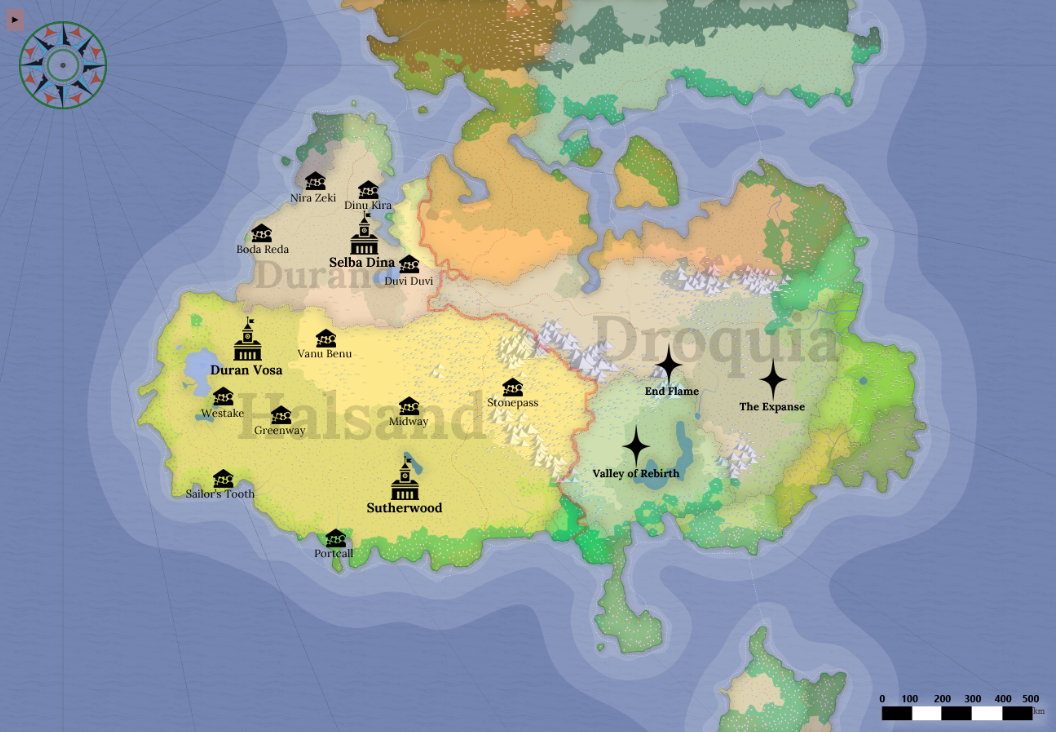
The Halsand empire consists of two regions, Halsand and Durand. Droquia is on the same landmass in the east.
Halsand
Halsand lies on the southwest of a continent shared with Durand and Droquia. It is a temperate region where the temperature usually lies between -5°C and 10°C in winter and 15°C to 25°C in summer. There are some mountains and hills as well as large forests housing a variety of wildlife. Halsand is the home of the Salsant and part of the Halsand Empire. The Salsant King of the Empire lives in Sutherwood to the south.Notable cities include:
Sutherwood, the capital of Halsand and the Halsand Empire. As with most Halsand architecture, most of the buildings are made of plastered brick masonry and wooden doors. Sutherwood is a technologically advanced city; most streets are lit at night and public infrastructure supports most consumer magitech vehicles. Homes are heated and provided with running water. The streets are often lively, as the city is a central point of research and development.
Duran Vosa functions as a Durand embassy and an economic hub for Halsand. Airship traffic into the country generally docks here and many businesses have set up shop. While still using Halsand construction techniques, the masonry has a decidedly Durand flair to it. The large, round shapes seen in Selba Dina are replicated on a smaller scale and attention to detail is obvious. Flags of both Halsand and Durand are displayed proudly and the streets are overflowing with colors from different banners and decorative tapestry.
Durand
Durand lies to the north of Halsand, west of Droquia. It is a warm desert area with large amounts of dunes. The climate is rather harsh, varying from 20°C to 30°C during the day to nearly 0°C at night. There are small mountains towards the east along with lush vegetation near the coast. Durand is home to the Lacasin and part of the Halsand Empire. The Lacasin Queen of the Empire lives in Selba Dina near the eastern coast.Notable cities include:
Selba Dina, the economic powerhouse of the Halsand Empire. Dozens of airships and sailing boats dock on a daily basis carrying wares from all over the world. The streets are never quiet, always filled with tourists and traders. Buildings are made of a sturdy sandstone, mixed with an adhesive found in local plant life. Durand architecture prefers large, round structures and Selba Dina is a perfect example. In the centre of the city stands a spire, serving as a docking bay for the many airships arriving and departing each day. On the lower level, built at a ring around it, is the royal palace. While built around the spire, the royal palace doesn’t directly connect to it. Exits from the spire lay below the palace, allowing visitors to enter and leave in any direction. Homes and businesses are built in a thick ringed structure around the central area.
Droquia
Droquia is the homeland of the Droquit. It consists of large open plains and grasslands and relatively few forests. The climate is mild and comparable to Halsand. Due to the low amount of forests, it is often very windy. Large segments of Droquia are covered in once molten rock and ash after a natural disaster that forced the Droquit into the Halsand Empire. Due to their nomadic nature, the Droquit never founded any major cities as they moved around the open plains as needed.Notable places include:
The Valley of Rebirth has an important role in Droquit history. Appearing as a large field of Astral Crystals, the valley is believed to be the resting place of souls awaiting rebirth. Crystals vary from size, ranging from only a few dozen centimetres to several metres tall. The valley sits next to a lake and has a cliffside on the opposite side, casting a shadow on the crystal fields
The End Flame is the catalyst to the calamity befalling Droquia several years ago. A dormant volcano awakened and covered most of the continent in fire and ash. One of the Great Tribes, the Silver Moon, was situated on the volcano at that time, then believed to be an ordinary mountain. The End Flame is an important site in pilgrimages done by many Droquit as they come of age, and it plays an important part in stories told about their old homeland.
The Expanse was once lush green plains and steppes. The Droquit once called this their home, before the End Flame erupted and turned the once lush fields into ash wastes. The Four Great Tribes traveled these plains once, setting up camp where resources were bountiful and leaving once they dwindled so that the land could recover. Now, only small bands of Droquit, commonly referred to as Ashlanders, roam these wastes and make a living off of the strange wildlife that has adapted to the new climate.
Isilia
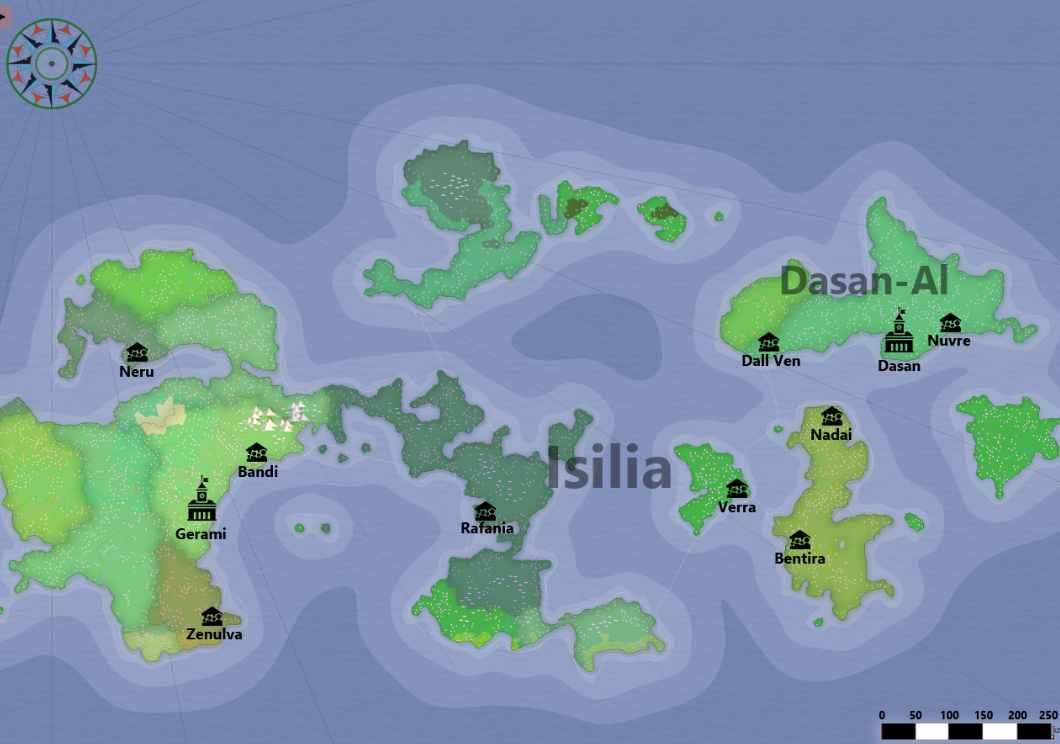
Isilia consists of two regions. Isilia itself, which makes up for most of the territory, and Dasan-Al. Dasan-Al is the result of the city Dasan trying to gain independence with Dall Ven and Nuvre, which has been an ongoing diplomatic conflict for some time.
Isilia is often described as a tropical paradise. Partially because of the beautiful terrain and warm climate coupled with lush plant life, partially as a joke because of the myriad dangers that hide in the jungles. A perfect vacation resort, if it weren’t for the giant murderous beasts. Isilia is populated with small settlements across the many islands and is in a good position for trade with the Halsand Empire to the east and Othenia to the southeast.
Notable cities include:
Gerami, the main capital of Isilia. Easily accessible by water, the impressive wooden structures give the city a strangely rustic feel despite its size. As with most Isilian cities, Gerami is surrounded by a tall wooden wall which, despite its obvious wear by assaulting wildlife, looks as if nothing could take it down. Citizens of Gerami are lively and easygoing, which can be seen by the children playing on the wooden walkways that serve as roads and the many stalls selling an impossible variety of food to passersby, often including the meat of gigantic creatures caught by the hunter groups that give Isilia its fame
Dasan is at first glance not so different from Gerami, though the careful observer will note that structures and walkways seem not as well-maintained. All in all, though, the people largely remain the same. Due to the current conflict with the Isilian mainland, the shops and people tend not to accept Silvers or ask for increased prices if no other currency is available. Most shops prefer Royal Seals, though Sel is widely accepted as well.
Othenia

The Othenian Kingdom exists on a large cold continent bordered by large ice sheets to the east. Civilization exists mostly on the western coast, while the sheets of ice on the eastern section cannot be built on due to frequent cracks occurring during storms and larger waves. Lindum and Sabaria are the exceptions, having found ice plates that are still supported by land below them.
Othenia lies a good distance to the south-southwest of the Halsand Empire. It is extremely cold; always well below 0°C and usually around -10°C to -5°C in summer, or -10°C to -20°C in winter. The cutting winds and snow forced most behind the tall walls of the Othenian Kingdom. Most settlements are situated on the western coast, as the entirety of the eastern coast consists of floating ice and is not suitable for building on.
Notable cities include:
Aventicum, the capital city of the Othenian Kingdom, is an impressive city that might as well be described as a fortress. Masonry consisting of large Blackstone, a type of rock found in large quantities underground, gives the city a dark, overwhelming aura. Despite this, proud Othenian citizens walk the streets, having adorned it with banners, flags and myriad other decorative items. Because of the cold climate, many fires are lit throughout the city which gives travelers a moment of respite and warmth. Not many stalls are seen on the streets, as most shops keep their business indoors where the temperature can be raised to a comfortable 10°C.
The Coriallum is a feat of engineering seen nowhere else in the world. Tall, glimmering walls of sculpted ice surround a massive castle made entirely out of ice blocks. Only in the core of the castle can you find stone buildings, carefully heated to acceptable temperatures as to not compromise the castle walls. While not used for many practical purposes, maintaining the Coriallum is a matter of tradition that Othenia takes very seriously. Each morning, as the sun rises, a brilliant display of light is reflected up from the Coriallum which can be seen from nearly anywhere on the frozen continent.